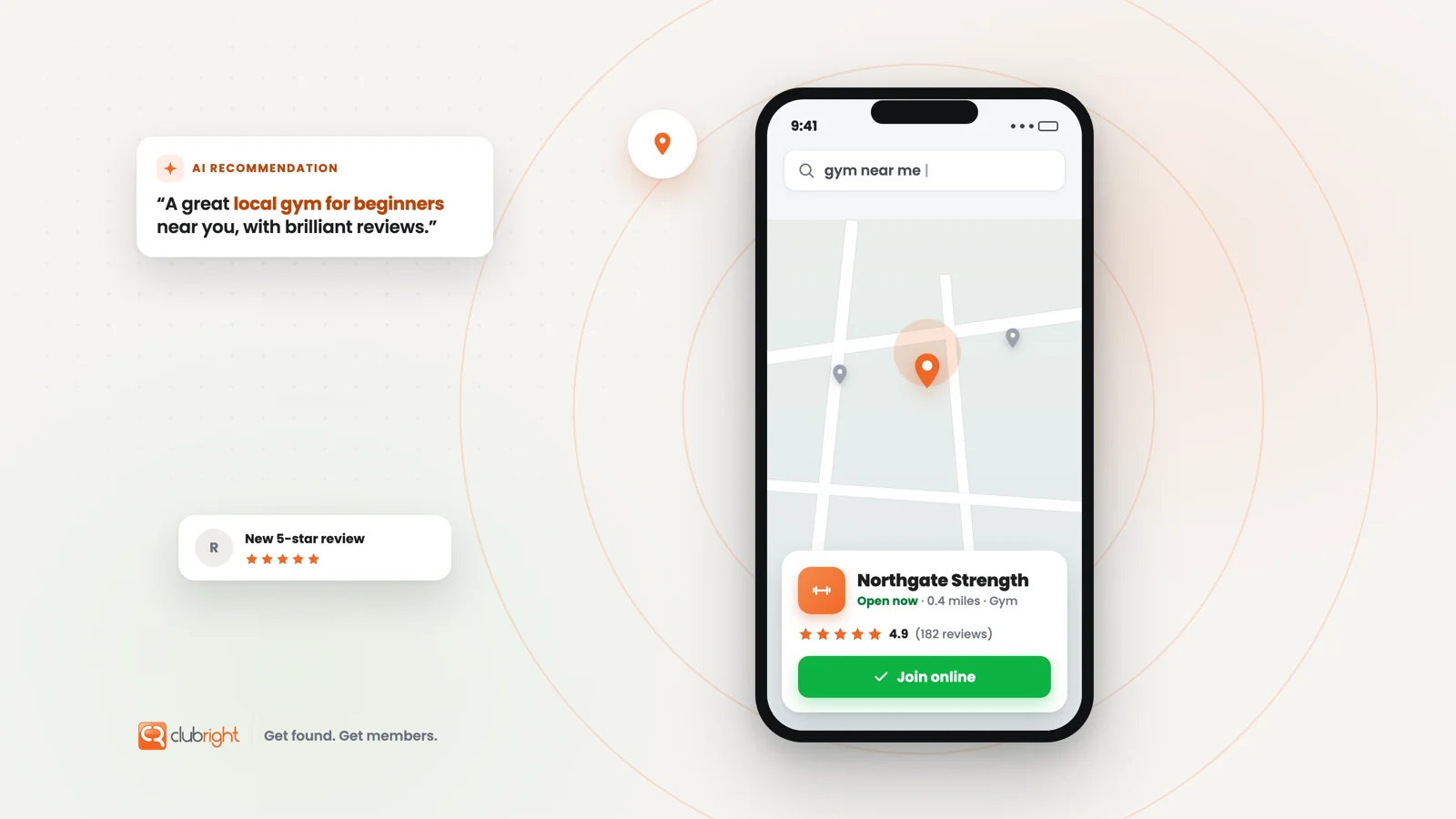
A practical guide for gyms and clubs: get found in local and AI search, then turn those searches into paying members. Works whether you have 80 members or 3,000.
When someone near you decides to join a gym, a martial arts academy or a boxing club, they reach for their phone. "Gym near me." "Boxing classes nearby." "Where can I start Pilates as a beginner?" And more and more, they ask an assistant: "What's a good gym near me for someone just getting started?"
Two things decide whether that person becomes your member. First, do you show up when they search. Second, once they land on you, does anything actually make them join. Most advice online only covers the first. This guide covers both, because a gym that gets found but doesn't convert is just paying for traffic that walks away.
It works whether you have 80 members or 3,000, and whether you do your own marketing or pay someone. And it's built around three jobs, in order: get found, convert the visit, and keep it all fresh, plus a fourth: knowing it's working.
The short version
To win members from online search, a gym needs to do three things. Get found locally: a complete, active Google Business Profile, steady reviews, and a website that search engines and AI can read. Convert the visit: an obvious path to join or book, with payment built in, so a visitor can become a member in minutes without leaving the site. Stay fresh: keep hours, prices, classes and photos current, because stale information quietly costs you rankings and trust. Do all three and you don't just appear in search, you turn it into paying members.
This is for you, even if you're not "techy"
Plenty of owners pay someone to "handle the website" because it feels like a technical job they can't do. If that's you, here's the reassuring bit: almost everything that actually wins you members nearby isn't technical at all. Keeping your opening hours right. Asking members for reviews. Putting your real prices and classes up. Adding a few good photos. You know all of this better than any outside agency ever could, because you know your club, your members and your town.
The genuinely technical part, building the site so Google and AI can read it properly, is a one-off. It should be built in and handled for you, not a bill every time something changes. So this isn't a choice between learning to code and paying an expert. It's doing the few simple things only you can do well, and letting the setup take care of the rest.
Short on time? Start with these three. A complete Google Business Profile, a steady habit of asking for reviews, and an obvious way to join online. They win you the most members for the least effort. Everything else below is how to go further.
One mindset shift first: think local, not national
The most common mistake gyms make online is aiming too wide. You are not competing with every gym in the country. You are competing for the people who could realistically travel to you, and almost all of them live within a short drive, often ten or fifteen minutes.
That changes everything about how you should spend your effort:
- A big, general search like "best gym" isn't worth chasing. You'll never beat the national chains for it, and the people typing that aren't looking for a gym near you anyway.
- The searches that name where you are, like "gym in your town", "boxing classes in your area" or "gym near me" typed on a phone nearby, are winnable, and those people are ready to join.
- Everything below is about being the obvious choice in your own area, not the whole country. Pick the town, the neighbourhoods and the landmarks people actually use, and be the answer there.
Get found by the right few thousand people nearby. Ignore the rest.
What you don't need (so you can stop feeling guilty)
There's a belief that a "good" website means a big one: dozens of blog posts, a bio for every coach, a library of videos, page after page. For getting found locally, most of that isn't doing the work you think it is.
Local ranking comes from your Google Business Profile, your reviews and a clear, accurate website, not from the size of your site. A handful of pages that answer real questions, what you offer, your prices, your timetable, how to join and where you are, will out-perform fifty thin blog posts every time.
If you've been putting off your website because it feels like a mountain of writing and filming, here's the good news: it isn't one. A few clear, accurate pages will do more for you than a pile of content you never have time to keep up to date.
Part 1: Get found in your area, and by AI
There are two search worlds and you need to show up in both. Traditional search: someone types "gym near me" and Google shows a map with three highlighted businesses (the "local pack") above the usual links. Getting into that top three is the highest-value move you can make. AI search: someone asks an AI in plain language, whether that's ChatGPT or Google's own AI Overview now sitting at the top of the searches they already do, and it names just one or two options and says why. Being one of those names is the new front page.
The reassuring part: the same work wins both. Both reward a club that's clearly described, consistently listed, well reviewed and genuinely useful.
Own your Google Business Profile
For a local business this often matters more than your website. It's the pin on the map and the box beside your name.
- Claim and verify it. An unverified profile is an open door for wrong information.
- Pick the right primary category (Gym, Martial Arts Club, Boxing Club, Pilates Studio), then add secondary ones. The category decides which searches you appear for.
- Complete everything: hours (including bank holidays), phone, website link, exact address, services.
- Add real photos, often: the floor, classes, the team, and the outside of the building so people find the door.
- Post offers and news, and answer the questions people ask on the profile (parking, joining fee, beginner-friendly).
Make reviews a habit
Reviews are the currency of local search: volume, recency and rating all feed both Google's ranking and the summary an AI gives when it recommends you.
- Ask every time, right after a good session or a milestone. A simple, direct ask beats a clever campaign.
- Make it one tap with a direct link or QR code to your Google review page.
- Reply to all of them. A calm response to a poor review reassures the next reader more than the five-star ones.
- Aim for a steady trickle, not a one-off flood.
Build a website search engines and AI can read
You don't need a big website, you need a clear one that machines understand. They read the structure and the signals behind the page, not just the words.
- One purpose and one main heading per page ("Boxing classes in your town"), not a homepage trying to be everything.
- Local, honest titles and descriptions: "Independent gym in your town, with your club's name" beats "Home".
- Mobile first. Nearly everyone searching for a gym is on a phone.
- The behind-the-scenes details that tell Google and AI exactly what you are: a gym or club, your address, hours, phone and rating. Most DIY builders skip this, and its absence is a real reason gyms don't show up in rich results or get named by AI.
- Consistent name, address and phone everywhere. A different phone number on an old directory makes Google unsure it can trust you, and uncertainty means you don't get shown.
Get named by AI search (the part most gyms ignore)
This is where you can get ahead, because your competitors haven't thought about it. When an assistant recommends a gym, it pulls from what it can find and trust about you: your site's clear description, those behind-the-scenes details, your reviews, and how consistently you're described elsewhere. To be one of the names it gives:
- Answer real questions in plain language on your site ("What is your club and who is it for?", "How do I start boxing as a beginner?").
- Add an FAQ section to key pages covering pricing, joining, classes, parking and contracts. It's some of the most AI-friendly content you can write.
- Keep facts consistent and current everywhere. AI distrusts contradictions.
- Reviews feed AI too. "Well reviewed for beginners" is an AI summarising your reviews.
Part 2: Turn those searches into members
Getting found is only half the job. Plenty of gyms rank well and still lose the visitor, because once someone lands, nothing tells them what to do next. A website's real job is to turn a stranger into a paying member. Treat it like your busiest front-of-house person.
- Make joining obvious and immediate. The single most important thing on the page is a clear way to join or book, visible without scrolling and repeated as they read. If someone has to hunt for it, or email you and wait, most won't.
- Let them join online, then and there. The strongest websites take a visitor from the homepage to a paid-up member without ever leaving the site: pick a membership, pay, done. Every step you add (a form, a phone call, a "we'll be in touch") loses people.
- Answer the objection before they ask. Price, contract terms, what's included, whether beginners are welcome. Uncertainty is the biggest reason a ready visitor doesn't act.
- Show proof. Real reviews, real photos, real member numbers. People join places other people clearly rate.
- Make it effortless on a phone, because that's where the decision happens. Big tap targets, fast path to join, no pinching and zooming.
A simple test: open your own site on your phone as if you'd never seen it, and time how long it takes to actually become a member. If it's more than a minute or two, that's members you're losing after doing all the hard work of getting found.
Part 3: Keep it fresh, or it goes stale fast
A website is not a leaflet you print once. Out-of-date information is one of the quiet killers of both ranking and conversion. Wrong opening hours, a class that no longer runs, last year's prices, a "new for January" banner in June, all of it tells Google (and a visitor) that nobody's home.
- Keep the essentials current: hours, prices and your class timetable. These are exactly the things people check before joining, and exactly what AI reads to describe you.
- Refresh little and often. A new photo, an updated timetable, a fresh offer. Activity signals a real, running business, and Google rewards pages that are kept up to date.
- Remove the dead stuff. A cancelled class or an expired offer left up does more harm than no offer at all.
- The practical problem: most gym websites go stale because changing them is a chore, a job for "when I get a minute" that never comes, or a message to a web developer that carries a wait and often a fee. The fix is a site you can change yourself in seconds. If updating a price or adding a class means a support ticket, a three-day wait or a bill, it won't happen, and your site drifts out of date, which is exactly what costs you rankings and trust.
The best setup is one where your website simply reflects your club. Set a membership live or add a class in your management system, and it's on the site the moment you save, nothing to update twice.
Part 4: Know if it's working, without becoming an analyst
Most gym owners don't measure any of this, which is fair enough when you're on the floor all day. But you don't need dashboards. A few simple signals tell you whether the three jobs above are actually working:
- Know how every new member found you. "How did you find us?" is the most useful thing you can track, and it shouldn't rely on your memory. ClubRight records it for every member, whether they join online or you sign them up at the desk, so you can see what's really bringing people in.
- Check your Google Business Profile insights (free, built in): how many people found you, and how many then called, asked for directions or clicked through to your site.
- Search your main terms from your phone, in your area, now and then. Do you come up near the top, or not?
- Watch whether visitors turn into members. ClubRight has a built-in website dashboard, so you can see how many people visited and how many actually joined, without wrestling with a separate analytics tool.
If you want a shortcut, ClubRight's free benchmark tool does the search side of this for you in about two minutes: your online presence, your local and AI search signals, and how you compare to 1,000+ UK clubs, with no sign-up to see where you stand. It turns this guide into a to-do list for your specific club.
What this really takes (time, not money)
The honest answer to "what will this cost me?" is: mostly time, and not much of it. Almost everything in this guide is free. Your Google Business Profile, your reviews, keeping your details consistent and your information current, none of it costs a penny. The one real cost is the website itself, and, with the wrong setup, paying someone each time it needs a change.
Two fair expectations to set:
- It builds, it isn't a switch you flip. A complete Google profile and a few fresh reviews can start showing within weeks. Getting a website ranking takes a few months of steady basics. Anyone promising you the top spot overnight is selling something.
- A little and often beats a big push. Ten minutes a week on reviews and keeping things current will do more than a burst of effort followed by six months of silence. Consistency is the whole game.
A few shortcuts that backfire
When results feel slow, the tempting shortcuts are the ones that get you penalised or ignored. Skip these:
- Buying or incentivising reviews. Google spots unnatural review patterns and can hide your profile for it. A slow, genuine trickle is worth far more than a paid-for burst, and members can tell the difference too.
- Repeating your town's name in every other sentence. It reads as spam to Google and to a real person. Say where you are naturally, once or twice, and move on.
- Setting up duplicate listings. One verified Google profile per location. Old or extra duplicates split your reviews and leave Google unsure which one is really you.
Your get-found-and-convert checklist
Get found in your area
- Your Google Business Profile is claimed and completely filled in
- You're listed as the right kind of club (gym, martial arts, boxing, and so on)
- You've added fresh photos this month
- Reviews are coming in steadily, and you reply to every one
- Each page of your site is about one thing, and its title says what you do and where
- Your site tells Google and AI what you are and where (the behind-the-scenes details most builders miss)
- Your name, address and phone number match everywhere they appear online
- You've a page answering the questions people actually ask: price, joining, parking, beginners
- You're aiming at your town and the area around it, not the whole country
Turn visitors into members
- There's an obvious "join" or "book" button people see straight away, without scrolling
- People can join and pay online in a couple of minutes, without leaving your site
- Price, contract and "beginners welcome" are answered up front
- Real proof is on show: reviews, photos, member numbers
- It's genuinely easy to use on a phone
Keep it fresh
- Your hours, prices and timetable are up to date
- Old classes and finished offers have been taken down
- You can update the site yourself in seconds, not with a support ticket
FAQ
How do I get my gym to show up on Google?
Start with a complete, active Google Business Profile and a steady flow of reviews, then make sure your website has clear local page titles and the behind-the-scenes details that describe your business. Focus on your own town and the area nearby, not the whole country. The profile and reviews move fastest, often within weeks.
Should I try to rank nationally?
No. Your members come from a realistic travel distance, usually a short drive. Aim to be the obvious choice for "gym in your town" and "near me" searches, not "best gym in the UK". Local is both winnable and where your actual members are.
Do I need to be on social media to get found?
Social media helps the people who already follow you stay interested, but it doesn't get you found by someone searching for a gym nearby. That job belongs to your Google profile, your reviews and your website. Think of social as keeping in touch with the people you've got, and search as bringing new ones to the door. If your time is tight, the search basics come first.
How do I get recommended by ChatGPT or Google's AI answers?
Be clearly described on your site, include the behind-the-scenes details that tell search engines what you are, keep your information consistent everywhere, answer real questions in plain language, and keep reviews coming. AI recommends the businesses it can understand and trust, which are the same things Google rewards.
My website gets visitors but no members. What's wrong?
Usually the path to join is unclear or too slow. Put an obvious way to join or book near the top of the page, let people pay online without leaving the site, answer price and contract questions up front, and test the whole thing on a phone.
Does the website my gym software gives me matter?
Yes. A site that's built the right way, lets people join online, and is easy to keep up to date does most of this for you. One that isn't leaves gaps you'll fix by hand, and tends to go stale. It's worth checking what yours actually includes.
Where ClubRight fits
Everything here works with any website and any tools. It's listed because it works, not because you need us for it.
Where ClubRight helps is doing all of this for you. Every plan includes a website that's built to be found (structured for the local searches that bring you members, and for AI assistants to recommend you), built to convert (clear ways to join and pay online, so a visitor becomes a member without leaving the site), and easy to keep fresh (set a membership or class live in ClubRight and it's on your site the moment you save, and you can change images and wording yourself in seconds). It even records how every new member found you, so you can see what's actually working. It's the platform behind 1,000+ UK and Ireland clubs, around 1 in 3 of whom double their membership, and it's included on every plan.
If you want to see how your club compares to 1,000+ UK clubs, run your free benchmark. It takes about two minutes.